
Off-Page SEO
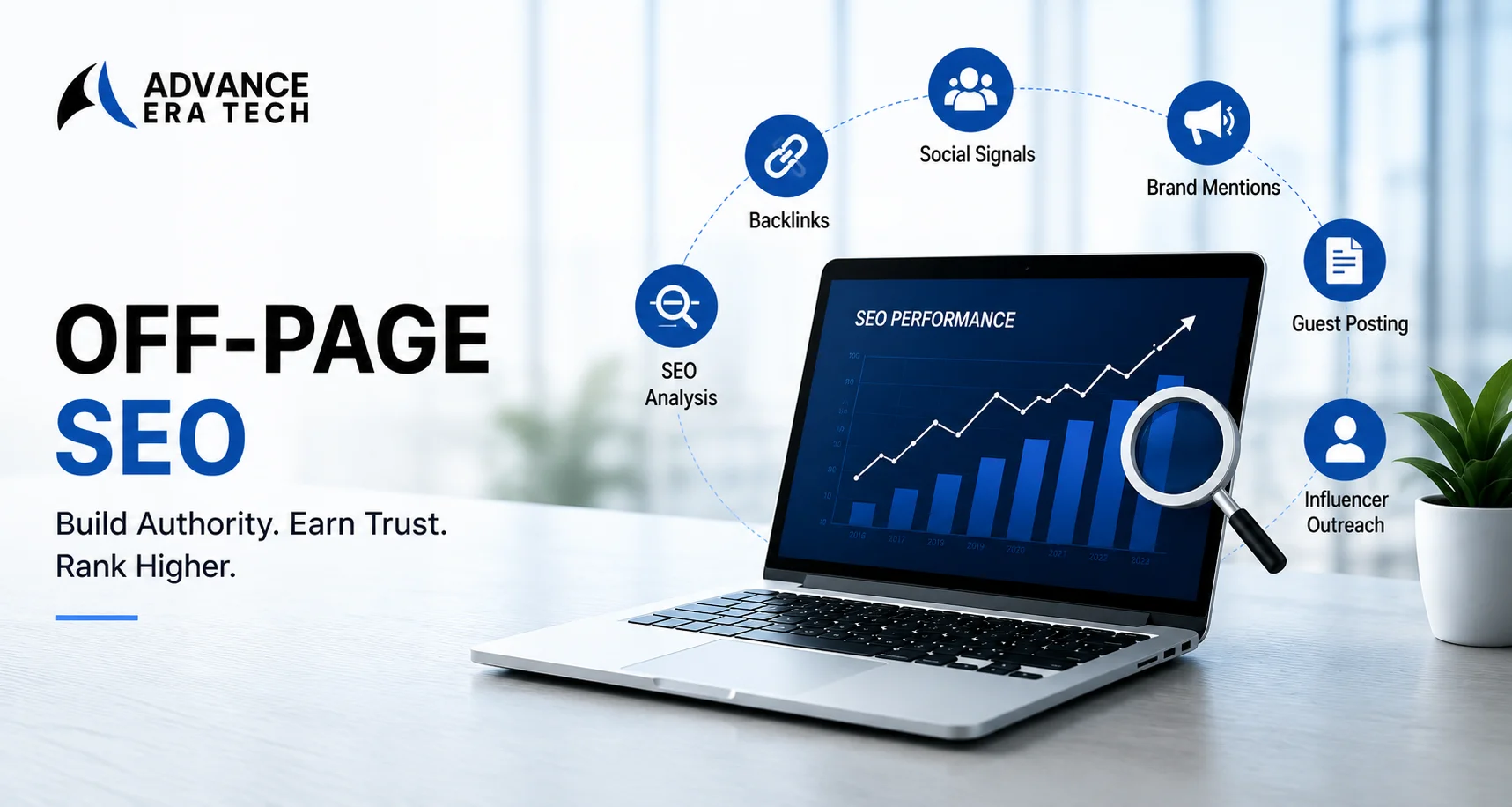
Off-page SEO covers all the work done outside your own website to improve its search rankings, visibility, authority, and reputation online. It’s different from on-page SEO, which deals with what you control directly on your site — content, headings, meta tags, internal links. Off-page SEO is about everything happening away from your site: who’s linking to you, who’s talking about you, and how much the rest of the internet actually trusts you.
In plain terms, off-page SEO is how you build a website’s reputation. Google doesn’t just take your word for it that your site is useful or authoritative — it looks for proof from outside sources. Backlinks from respected websites, brand mentions across the web, genuine reviews, and social signals all tell Google one thing: real people and real websites vouch for this site, so it deserves to rank higher.
Why Off-Page SEO Matters for Businesses?
The digital economy is growing fast — genuinely one of the quicker-moving ones in the region — and that means more businesses in cities like Karachi, Lahore, Islamabad, Rawalpindi, Faisalabad, Multan, and Peshawar are fighting for the same customers online every single day. At Advance Era Tech, we see this play out constantly: a website with a weak off-page presence isn’t just missing out on a few backlinks, it’s quietly losing paying customers to a competitor who’s simply more trusted in Google’s point of view.
This is exactly why off-page SEO can’t be treated as optional anymore. Here’s what solid off-page work actually does for a Pakistani business:
- Domain authority — built through genuine, relevant backlinks rather than volume for its own sake.
- Brand trust and credibility — strengthened across the web, not just on your own site.
- Organic traffic — increased as your site starts ranking for more competitive keywords.
- Local search visibility — improved city by city, since ranking well in Lahore means nothing for a customer searching in Peshawar.
- Rankings protection — by clearing out toxic or spammy links before they trigger a penalty.
- Compounding reputation — the more genuinely trusted your site becomes, the easier future link building gets.
Off-Page SEO Ranking Factors
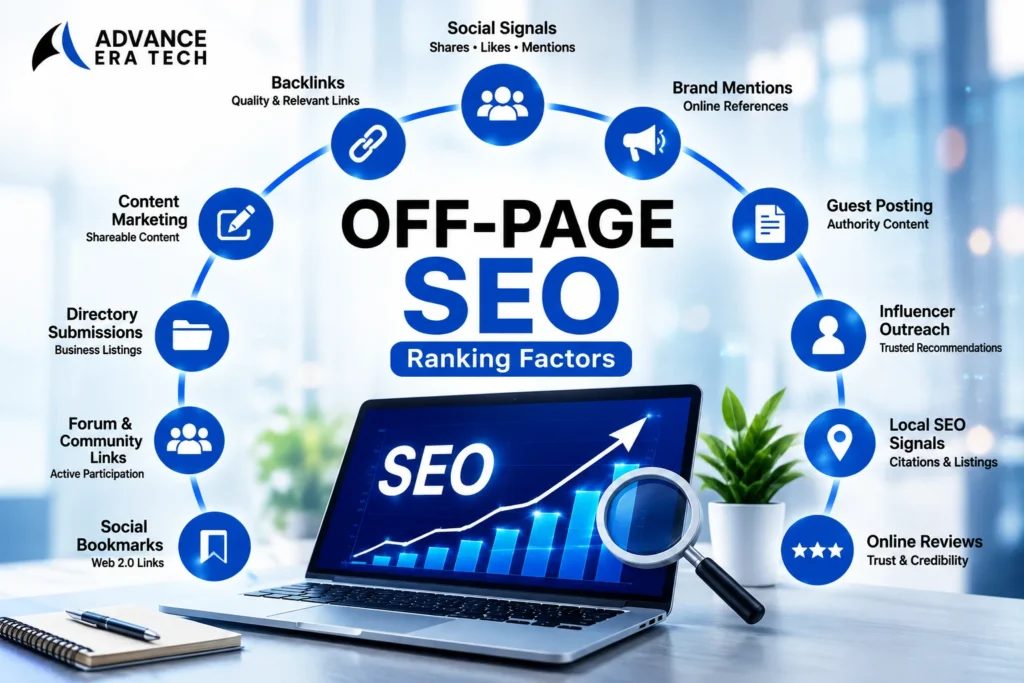
People throw around the term “off-page SEO” like it means one thing. It doesn’t. Some of these factors carry real weight, some just support the ones that do — here’s the breakdown, starting with what matters most. Our SEO service agency will provide the best SEO service following legal rules of Google.
Core Off-Page SEO Ranking Factors
- Backlink quality over backlink count
One link from a trusted, relevant site will outperform fifty from random low-authority blogs, full stop. That’s why nothing goes out the door before we’ve checked domain rating, referring domains, and whether the source has any real trust attached to it. - Domain authority and trust score
Google doesn’t grade each link in a vacuum. It’s weighing the whole picture — and a few genuinely strong domains will usually beat a long, padded list of weak, unrelated ones. - Anchor text and link profile balance
This is where a lot of sites get penalized without realizing why. Keep the anchor text too optimized and it starts looking manufactured — because it is. We mix branded, generic, and partial-match naturally, the way a real link profile would grow on its own. - Referring domain diversity
Fifty links from two sources isn’t diversity, it’s concentration, and Google can tell. Ten different real domains linking to you will carry more weight than a stack of links all coming from the same handful of places. - Topical authority
Sites that stay in their lane tend to outrank the ones spread across ten unrelated subjects. So we don’t chase links wherever they’ll land — the link building and content syndication work stays tied to your actual niche. - Local citations and NAP consistency
Sounds small. Isn’t. If your Name, Address, and Phone number don’t match across Google Business Profile, directories, and social — that inconsistency alone can quietly tank your local rankings, no penalty needed.
All Off-Page SEO Ranking Factors
- Brand mentions and entity signals
Not every mention needs a link. Even the unlinked ones tell Google you’re a real, established business and not just a domain floating around — which is more or less what entity-based SEO is built on. - Referral traffic and engagement
A link that never gets clicked eventually looks a little off, even if there’s nothing technically wrong with it. Links that bring real people carry more weight than ones just sitting there. - Backlink relevance
Context matters as much as the source. The same link means very little dropped on a random page, and a lot more sitting inside content that’s actually about your industry. - Follow vs nofollow ratio
A profile that’s 100% dofollow doesn’t happen naturally — and Google’s aware of that. A realistic mix, nofollow links included, is what an organically grown profile actually looks like. - Link velocity
Grow too fast and it looks staged. Slow, steady growth is what earns trust over time — there’s no shortcut around this one. - Social signals
Shares and engagement on Facebook or LinkedIn won’t move your rankings on their own, but they expand your reach. And reach is often where the mentions and links that do matter come from. - Online reviews and reputation
Honest reviews, steadily earned over time, beat a sudden pile of them every time. Google’s gotten fairly good at spotting the difference, and reviews carry weight with users just as much as with the algorithm. - Guest blogging and digital PR
Out of everything we do, getting placed on a niche-relevant site or picked up through HARO tends to produce the strongest trust signals, period. Slower than buying links. Actually holds up though. - Forum and community engagement
Real participation on Quora or industry forums puts you in front of people already asking the questions you can answer — and every now and then, it earns a link too. - Press releases and media coverage
One placement on a credible outlet can outweigh a dozen directory submissions. It’s less about how many, more about whose name is next to yours. - Domain age and historical consistency
Older domains with a steady link history tend to carry more built-in trust — not because age itself ranks you, but because it usually signals a longer track record of being a real, functioning business. - Social bookmarking and directory listings
The right niche directories add a small, genuine signal. Bulk submissions to low-quality ones? Often does more harm than good. - Video and image sharing signals
Traffic and links earned through platforms like YouTube add another dimension to your entity signals beyond just text. - User-generated content and mentions
Organic conversation about your brand on forums and Q&A sites tells Google you’re relevant in the real world, link or no link. - Influencer and long-term partnerships
A one-off shoutout fades fast. An actual ongoing relationship with the right voices in your space builds exposure that keeps compounding. - High-authority citation mentions
A mention from a major publication is about as strong a trust signal as it gets — though not every business is at a stage where that’s realistic just yet, and that’s fine. - Toxic links and disavow management
Old links from PBNs or spammy directories can sit on a profile for years without anyone noticing, quietly dragging it down. Finding and disavowing those before they turn into a real problem is part of every audit we run.
Businesses We Serve
Advance Era Tech is serving mostly startups, SMEs, ecommerce stores on WooCommerce or Shopify, and a fair number of real estate agencies and healthcare clinics — industries where local trust and search visibility genuinely decide whether the phone rings. If you’re a service business trying to outrank a bigger, better-funded competitor, this is usually where we start.
Benefits of Off-Page SEO
We won’t tell you off-page SEO works overnight, because it doesn’t, and any agency that promises page-one rankings in two weeks is either lying or about to get you penalized. What we can say is that most clients start seeing measurable movement — referring domains climbing, search visibility improving, organic traffic ticking up — within a few months of consistent work. From there it compounds.
Why People Choose Advance Era Tech
We’ve seen enough “off-page SEO packages” built on a thousand low-quality directory submissions to know that’s not a strategy, it’s a shortcut that eventually backfires. Our approach is slower on purpose — fewer links, better sources, real relationships with publishers, and a constant eye on the ranking factors Google actually cares about right now.
Off-page SEO isn't about link count. It's about earned trust.
The businesses that win long-term aren’t the ones with the biggest link count, they’re the ones Google, and real users, genuinely trust. That trust gets built one relevant backlink, one honest mention, one positive review at a time.
Frequently Asked Questions
On-page is the stuff you control directly — your content, site structure, speed, all the technical bits. Off-page is everything happening outside your site that still shapes how Google sees it: backlinks, mentions, citations, reviews, general trust in the eyes of the internet.
Give it two to four months before expecting anything solid. Referring domains start climbing, visibility improves, organic traffic ticks up — that’s usually the pattern. If someone’s promising you page one in two weeks, be skeptical.
Not really, no. Link building is a piece of it, but there’s also digital PR, brand mentions, citations, social signals, and cleaning out any toxic links dragging you down.
It does, more than most people assume going in. Keeping your NAP details consistent, building proper local citations, having an active Google Business Profile — all of that plays directly into local visibility.
Nothing goes out without a manual check first — we look at relevance, authority, and what else that site is linked to. PBNs and link farms are off the table entirely.
Honestly, no — and we won’t pretend otherwise. Nobody outside Google controls Google’s algorithm. What we can guarantee is honest reporting and a strategy built around what genuinely affects rankings.
Not much, really — access to your Google Search Console and Business Profile if you have one, plus a bit of context on your industry and what you’re currently doing for SEO.
Contact Us
Ready to see where your backlink profile actually stands? Reach out to Advance Era Tech for a free, no-obligation off-page SEO audit.
Phone: +92 336 6446894
Email: [email protected]